
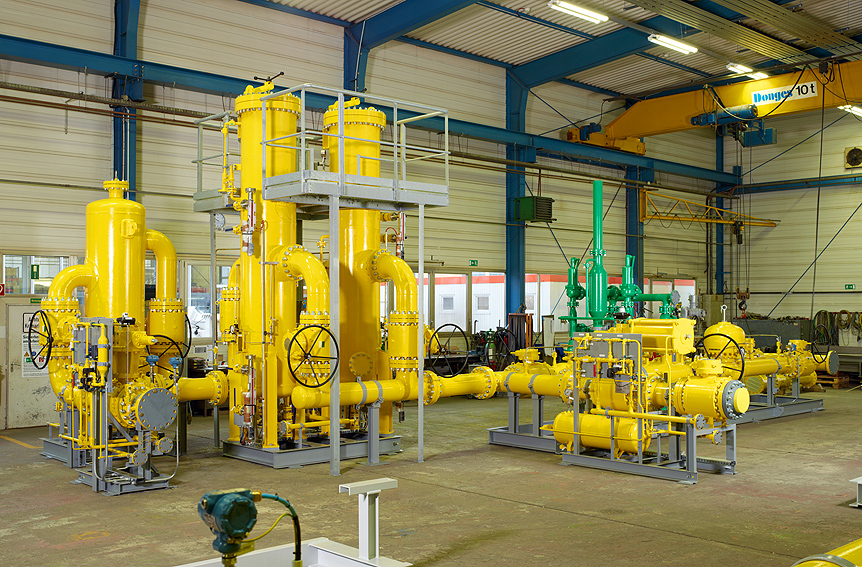
General
A Fuel Gas Supply System, often referred to as a Gas Receiving Station (GRS), is much more than a combination of individual equipment and components. It is a fully integrated process system in which all components must be carefully selected, sized, and coordinated to ensure safe, reliable, and stable gas supply under all specified operating conditions.
The system receives clean and dry natural gas from the gas pipeline at the defined transfer point and delivers the gas to the downstream consumer(s) at the pressure, temperature, flow, cleanliness, and gas quality conditions specified by the respective consumer or gas turbine manufacturer.
Designing such a system requires a high level of engineering experience and a thorough understanding of the interaction between all individual process stages. Filtration, metering, gas heating, pressure regulation, safety systems, piping, instrumentation, and control cannot be considered independently. Changes in one part of the system can directly influence the performance and operating conditions of subsequent equipment.
Particular attention must therefore be given to the interaction between gas flow, pressure reduction, temperature behaviour, pressure and temperature control, equipment pressure losses, gas quality, transient operating conditions, and the specific requirements of the downstream consumers.
A properly engineered Fuel Gas Supply System ensures that all individual components work together as one coordinated and integrated system – from the pipeline interface to the final consumer.
The complete installation is designed to provide stable and reliable operation throughout the entire specified operating range, including start-up, minimum and maximum load, load changes, shutdown conditions, and the applicable ambient conditions.
Main Components of a Fuel Gas Supply System
A complete Fuel Gas Supply System can generally be divided into two main sections:
Main Gas System / Gas Receiving Station (GRS)
The Main Gas System provides the central treatment and conditioning of the incoming natural gas before distribution to the downstream consumers.
Typical systems and equipment include:
- Emergency Shut-Down (ESD) System
- Gas Scrubbers and Filtration Systems
- Custody Metering System
- Condensate Collection, Removal, and Disposal System
- Fuel Gas Dew Point Heating System
- Pressure Reduction and Regulation System
- Safety and Overpressure Protection Systems
- Venting, Blowdown, and Inert Gas Purging Systems
- Gas Distribution Piping and Valves
- Control and Instrumentation Panels
- Gas Chromatograph / Gas Quality Measurement
- Associated Instrumentation and Auxiliary Systems
- etc.
Gas Turbine-Related Systems
Downstream of the Main Gas System, dedicated gas turbine-related systems provide the final conditioning and protection required for each individual gas turbine.
Typical systems and equipment include:
- Gas Turbine Metering System
- Fuel Gas Efficiency/Performance Heating System
- Final Fuel Gas Filtration System
- Condensate Collection, Removal, and Disposal System
- Venting, Blowdown, and Inert Gas Purging Systems
- Gas Distribution Piping and Valves
- Control and Instrumentation Panels
- Associated Instrumentation and Auxiliary Systems
- etc.
Integrated Engineering—The Key to a Reliable Fuel Gas System
The performance and reliability of a Fuel Gas Supply System depend not only on the quality of its individual components, but primarily on how well these components are engineered to work together.
Pressure regulators must respond correctly to changing gas turbine demand. Heating systems must consider the temperature reduction resulting from pressure reduction and ensure sufficient temperature margin under all operating conditions. Filters and separators must provide the required gas cleanliness while maintaining acceptable pressure losses. Metering systems require suitable flow conditions, while the piping layout, valves, instrumentation, and control philosophy must support stable operation of the complete process.
This interaction becomes particularly important during transient conditions such as gas turbine start-up, rapid load changes, trips, or switching between operating and standby trains.
For this reason, the successful design of a Fuel Gas Supply System requires extensive experience in process engineering, equipment selection, system integration, and gas turbine fuel gas requirements.
Redundancy and Availability
Depending on plant requirements, the Fuel Gas Supply System can be designed with redundant equipment or parallel treatment trains, allowing individual components or complete trains to be isolated for inspection or maintenance without interrupting the required fuel gas supply.
The redundancy concept is developed as part of the overall system design and considers plant availability requirements, operating philosophy, number and type of consumers, equipment criticality, and maintenance requirements.
The result is not simply a collection of individual components but a complete, coordinated Fuel Gas Supply and Conditioning System engineered as one integrated solution.